Showing posts with label Lebanon. Show all posts

Wednesday, December 13, 2006

Bush attacks Syria


Despite the Baker-Hamilton report which urged the president to begin negotiations with Syria, President George W. Bush vehemently criticized the Syrian regime. Bush expressed support for Syrians who wish for a democracy in their country and said that they deserve a law abiding government.

What prompted Bush's statements are reports of the conditions in which political prisoners are held in Syria, some are deprived of medical care and others are imprisoned with violent criminals. Bush is also concerned with Syria's meddling in Lebanese politics. Syria is suspected of the killing of a Lebanese minister a few weeks ago.

Syria controlled Lebanon by force and had troops stationed there until it was forced to withdraw by local and international pressure. Syria hosts headquarters of several Palestinian terror organization and foments violence in Lebanon and Iraq.

Tuesday, December 12, 2006

Annan draws his vision of the Middle East


Secretary General of the United Nations, Kofi Annan, related today his vision of the Arab-Israeli conflict:

Two states, Israel and Palestine living side by side in peace. The borders of the two countries will be based on the border of 1967 and the capital of the two states will be a divided Jerusalem.

The issue of Palestinian refugees will be solved within the boundaries of the Palestinian state and would not involve resettlement in Israel.

As to Syria and Lebanon: the two countries will have full diplomatic relations with Israel.

Annan claimed that both sides have a way to go in order to fulfill his vision and that each side must recognize the hardship it is causing the other. Only by accepting some of the other's view point can an agreement be made. Annan accepted Israel's position that terrorism did not equal unintentional harm which has befallen Palestinian citizens during IDF operations but did not absolve Israel of responsibility for it.

Sunday, December 10, 2006

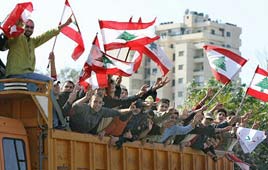
Hundreds of thousands in Beirut mass protest


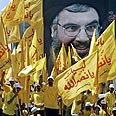
Hundreds of thousands of pro-Hezbollah protesters converged today in Beirut's two main plazas in a massive demonstration against the government of Fouad Siniora. This is the second mass demonstration held by Hezbollah in the last few weeks.

Hezbollah is calling for the resignation of Fouad Siniora as the latter rejected their demand to increase their number of cabinet seats to a third of the total, giving them virtual veto power. Many fear that further steps will betaken against the government and violence may soon ensue.

Hezbollah is expected to declare further steps which will be taken against the government including road blockades and increasing mass protests.

Hezbollah is supported by Syria and Iran and many in the West fear that it has begun a move to take over Lebanon.

Sunday, December 3, 2006

The IDF's activity in the West Bank will continue


In today's meeting of the Israeli government, the Israeli security minister, Amir Peretz, reviewed the security situation of Israel.

Due to the continued efforts of Palestinian terrorists in the West Bank to commit attacks on Israeli citizens, it was decided that the ceasefire which was proclaimed in the Gaza Strip will not be expanded to te West Bank at this time.

Further, Peretz, reported that massive smuggling of weaponry and funds to the Gaza Strip from the Siani desert continue unabated. What the Palestinians are arming themselves for can easily be surmised.

In Lebanon, several caches of munitions were discovered since the end of the war there last summer. Peretz reported that Hezbollah is rearming itself by smuggling weapons from Syria. Despite UN forces deployment, the border between Lebanon and Syria is far from sealed.

Peretz also related the humanitarian efforts the IDF is making in the Gaza Strip, efforts which are undermined by the continued infractions of the ceasefire by the Palestinians.

Saturday, December 2, 2006

Mubarak warns of deterioration in Lebanon


Egyptian pres. Mubarak warned today that the protests in Lebanon may turn to be a battlefield. yesterday, hunderds of thousands of pro-syrian and Hezbolah supportes demonstrated in Beirut against the incumbent Labanese government. Thousands remain in tents and swear to continue protesting until the govenment falls. PM Siniora called for peaceful resolution of the disagreements between the government and opposition.

Mubarak warned that should extremists take part in the protests it could draw more extremists from out of Lebanon and may spark violence.

Trade and social life in Beirut was paralyzed throughout the week as tensions escalated in the Lebanese capital.

Friday, December 1, 2006

800,000 protested in a mass demonstration in Beirut


800,000 people participated today in a mass demonstration in Beirut which was organized by the pro-syrian Lebanse opposition headed by terrorist organization, Hezbollah. The demonstration called for the resignation of Lebanese Prime Minsiter, Fouad Siniora.

The leader of Hezbollah, Hassan Nassrallah, did not address the crowds in today's demonstration, and the flag of Hezbollah was not displayed by the crowds so as to obscure the connection between the opposition and Hezbollah.

Siniora, who is under heavy security due to the demonstartion and threats on his life, declared that he will not give in to the protesters.

The opposition announced that they will take further steps to overthrow the government including bloackading streets in Beirut.

Today's demonstration is another step in what many fear is a slippery slope towards another civil war in Lebanon.

Hezbollah mass demonstration in Beirut


Thousands of Lebanese citizens are pouring into Beirut this afternoon to join what is promised to be a mass demonstration organized by the Lebanese opposition headed by the terrorist organization, Hezbollah. The opposition is calling for the establishment of a national unity government in which it will hold a third of the seats. Under Lebanese law, such a third will allow it virtual veto power over any decision and automatically topple the government should it choose to resign from it. Lebanse Prime Minister Fouad Siniora has rejected the opposition's demand.


Unprecedented security measures have been taken in Beirut around the residence of Siniora as the government is calling oday's demonstration an attempted coup by Hezbollah. Tensions in Lebanon have been high since the war with Israel last summer and the recent assassination of cabinet minister, Pierre Gemayel.


Many fear that today's demonstration is just anoher step in a downward slope to another civil war in Lebanon.

Thursday, November 30, 2006

The Prime Minister of Lebanon in conflict with Hezbollah


Lebanese PM, Fouad Siniora, addressed the Lebanese people today on national television. Siniora spoke against the Hezbollah led Lebanese opposition who is planning to hold mass demonstrations tomorrow in Beirut. Hezbollah demands the immediate establishment of a national unity government and threatens to topple Siniora's duly elected one. Siniora expressed concern for Lebanon and its democracy and called on the public to support the goverment. Siniora went on to state that the government will only be brought down by political means and not by threats or ultimatums.

Nassrallah calls for demonstration in Beirut tomorrow


The leader of the lebanese terrorist organization, Hezbollah, called today in a television interview for people to go out in a non-violent demonstration tomorrow in Beirut. Nasrallah calls for the replacement of the current government of Lebanon, headed by Fouad Siniora, by a national unity government. Nasrallah claims that the incumbent goverment has failed to protect the interests of Lebanon. This demonstartion comes in the wake of the resignations of 3 Hezbollah appointed ministers from the government of Siniora a few weeks ago after their demands for additonal offices were denied. The tension between Hezbollah and Siniora arose during the war with Israel last summer. The war which began as Hezbollah kidnapped two Israeli soldiers, brought great destruction to Lebanon. Ever since, the tensions have been high and there are fears of impending civil war.
Hezbollah is supported by Syria and Iran and it is feared that its goal is to topple Siniora's government and to form an Islamic republic on the northern border of Israel. Hezbollah is an active organization and is responsible for the killing of French, American and Israeli soldiers and for the bombing of jewish institutions in Argentina.

Wednesday, November 29, 2006

Syrian backed assassination group uncovered

Early today a Lebanese newspaper reported that a 200 member assassination organization was uncovered this week in Lebanon. The organization (still nameless) was established by Syria and its reported goal was to carry out assassinations of 36 prominent Lebanese officials and persons of influence who oppose Syria's habit of meddling in Lebanese affairs. Syria has been an active force in Lebanon for decades and had to withdraw its forces out of Lebanon only last year as a result of pressure by the United States. But Syria's fingerprints can easily be read in great areas of internal affairs in Lebanon, such as its active support for Hezbollah and its relentless interference in Lebanese politics. Syria has also been blamed for the killing of former Lebanese Prime Minister, Rafik Hariri, last year. This killing provoked great protests in Lebanon against Syria. The recent shooting of Lebanese minister, Pierre Gemayel, is likewise perceived as an action taken by Syria to silence another of its antagonists inside Lebanon. The son of Rafik Hariri, a politician himself, called the Syrian regime: an administration of murder. Many in Lebanon fear that Syria is trying to reassert its control over Lebanon and that the killing of Gemayel will not be the last political assassination in the near future.

29th of November - The Holy Land

The Israeli Defense Force (IDF) will increase the level and intensity of training during 2007. This was stated by various military sources and is a direct (and expected) result of the war with Lebanese terrorist group, Hezbollah, which waged during July and August. Many faults were discovered during the war, in which Israel lost over 130 soldiers and had many of its northern towns and cities bombed repeatedly with rockets launched out of Lebanon. Many of these faults were attributed to the decrease in combat training in the IDF over the last few years. Many of the reserve soldiers who took part in the war found themselves to be rusty if not altogether unfamiliar with part of the equipment and weaponery and with coordinated combat procedures. This the IDF aims to change in preparation for another conflict with Hezbollah or even Syria and Iran. The IDF has been promised a massive increase in the budget of 2007 in order to finance this increase as well as the necessary replenishment of its munitions. Several intelligence assessments predict a military conflict as early as 2007 in the northern border of Israel coupled with increased terrorist activities in the Gaza strip.

Tuesday, November 28, 2006

November 28th, 2006 - no.2 - The Holy Land

Three Israeli soldiers remain imprisoned by terrorists. Gilad Shalit was abducted from an outpost in the Negev by Palestinian militants who took him into the Gaza strip. two other Israeli soldiers were attacked during a border patrol by members of the Hezbollah organization and taken into Lebanon in what proved to be the Casus Beli of the was which waged between the Israel and the Lebanese terrorist group. The condition and whereabouts of the three soldiers is unknown, though news of an impending deal regarding the release of Gilad Shalit is common.
Israel's PM, Ehud Olmert, expressed in a speech yesterday his willingness to release many Palestinian prisoners held in Israeli jails in exchange for Gilad Shalit. He also called upon the Palestinians to return to the negotiating table and declared the for a true and lasting peace Israel will be willing to withdraw from many territories in the West Bank. This aroused great opposition within Israel as the Israeli army (IDF) has already withdrawn from the Gaza strip a little over a year ago and rockets are still being launched against Israeli population centers to this day.

November 28th, 2006 - The Holy Land

The ceasefire between Israel and the Palestinian militants again proved fragile today as a Kassam missile was launched from the Gaza strip and landed in the west of the Negev (Israel's southern area). The ceasefire had already been broken within minutes of its proclamation two days ago as missiles landed in the city of Sderot in the south of Israel. The city's population, which suffered numerous casualties in the last few weeks due to increasing missile launches out of Gaza, was unprepared for this breach. The sirens caught many of the residents out of their homes and away from shelter. Though no casualties were reported today, the ceasefire is viewed by many Israeli's as a shaky deal at best.
The ceasefire was negotiated between Israel's Prime Minister (PM), Ehud Olmert, and the president of the Palestinian Authority(PA), Mahmud Abas. Abas, of the Fatah part, has reiterated his call for resumed negotiations with Israel, but the frequent breaches of the ceasefire cause many in Israel and the international community to doubt the level of control Abas has over his own people.